Wooden welding rods versus wood-welding research
The catalogue joke imagines a consumable for welding ordinary timber as though it were the stated metalwork operation. That fictional stock order is different from specialised research using the term wood welding. EPFL’s timber research account describes adhesive-free friction-welded wood bonds.
This is why “wood welding can never be real” is an inaccurate reveal. A research process, an ordinary timber joint and the supposed packet of wooden metalwork electrodes are different propositions. The wood-welding-rods entry keeps the folklore claim specific.
An original short exchange is “Do you mean that named joining process or the imaginary rods?” followed by the intended answer. The terminology can be explained without attempting a process. A genuine technical request needs its actual material and operation identified, rather than a conclusion drawn from two familiar words.
Sky hooks are real names, not unsupported magic
The imaginary sky hook carries a load from thin air. Its missing support is the joke. Sky Hook’s manufacturer catalogue also identifies genuine lifting devices with fixed and mobile base arrangements. Their existence does not make the floating folklore version real.
The sky-hook explanation gives both meanings. A model and actual support arrangement identify the literal product; a promise that nothing supports it identifies the fiction. This is a naming distinction, not a lifting plan or assessment of particular equipment.
An original comeback is “Has the sky supplied its mounting details?” The answer can be “No—that was the imaginary support.” A search result can therefore be genuine without settling the joke. Ask what the item is supposed to do, rather than debating whether anybody has ever printed the name on equipment.
The magnet request needs a material and a method
The brass / aluminium magnet joke promises ordinary pickup behaviour with workshop chips that do not respond like iron to that basic tool. Brass, copper and aluminium variants share the claimed convenience and one canonical explanation.
The broad word non-ferrous is not a complete physics lesson. Special electromagnetic effects and industrial separation processes are another subject. Finding such a process does not establish the plain static pickup tool imagined in the errand. The actual material and collection method decide what a literal request means.
An original clarification is “Which material and which collection method?” In a fictional exchange, “The ordinary pickup feature was the imaginary part” gives the reveal. The story concerns a misleading supplies name; it does not require anyone to collect chips or stage a test around machinery.
Part stretchers promise more than a forming process
An undersize finished part makes the fictional plate / part stretcher sound attractive. The joke promises a universal correction while skipping the actual operation and specification. Metal forming and stretching can be genuine processes without reversing every finished dimensional error.
This shares a mechanism with a board stretcher: a convenient name supplies the hoped-for result. The relevant question is the actual machine, material, process and required outcome. “It makes it right again” does not identify those details.
An original comeback is “Does it restore the drawing requirements too?” It points to what the promise leaves out. The real dimensional issue belongs with the responsible process, while the fictional conversation can end with a laugh. Compare add-a-thou paste for another imagined universal repair.
Four verdicts for a fabrication-shop joke list
Wooden rods confuse the material and operation, with a genuine research term nearby. Sky hooks confuse a real product name with unsupported lifting. A brass magnet confuses ordinary pickup behaviour with other magnetic processes. A part stretcher turns a real process category into an unspecified cure-all.
A useful quiz asks for the missing detail after each guess. It does not reward whoever most confidently says every strange name is fake. A learner who asks for the process or model has identified the exact uncertainty that the joke borrowed.
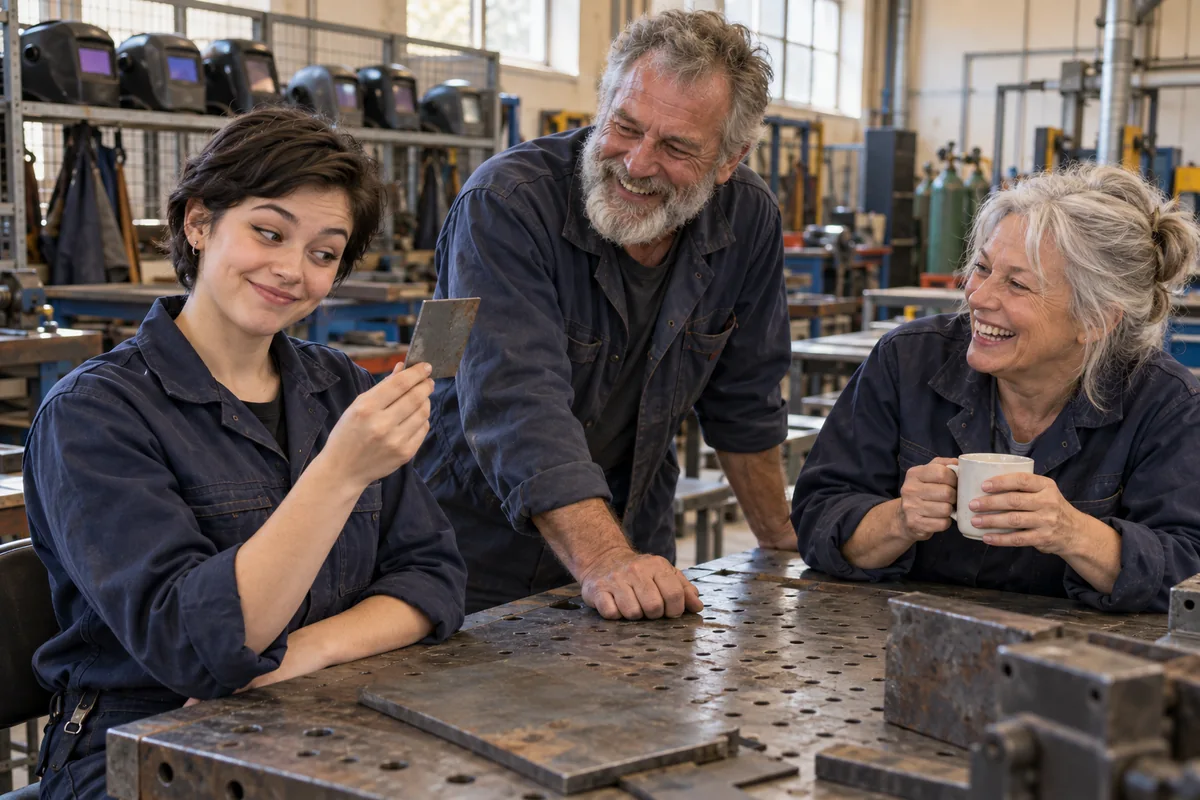
Explore welder apprentice jokes and machine-shop naming traps. Our fictional welding supplies story makes the stock-order reveal the whole event. Real equipment and consumables are identified literally; the playful catalogue lives in the conversation beside them.
Worked examples: names and explanations
Quick answers to the names in this guide. Each entry has the full explanation, alternative names and a comeback.
Wood welding rods
Ordinary metal-arc welding rods made of wood to repair lumber are an imaginary supplies joke. Joining wood, welding thermoplastics and specialist bonding research are real topics; they do not validate this fictitious rod for a standard welding job.
A useful question: Ask for the approved consumable and its actual material specification. The fake label should never reach a real welding setup.
Sky hook
A sky hook that supports a load from thin air is a joke. Real lifting products use the name Skyhook, so the name alone is not proof of a prank. The imaginary version has no supporting structure at all.
A useful question: The tell is “hang it from nothing”. A real item with a product name needs a model and an actual support arrangement.
Brass / aluminium magnet
The ordinary pickup magnet that conveniently collects brass, copper or aluminium workshop chips is a joke. Those metals do not respond like iron to a basic pickup magnet. Special electromagnetic effects and industrial separation processes are a different subject.
A useful question: Ask for the actual collection method and tool. Do not demonstrate the joke around running machinery or put hands into swarf.
Plate / part stretcher
A part stretcher that restores an undersize finished component is a machining joke. Industrial stretching and forming equipment are real; they do not provide an automatic, specification-preserving undo button for any cut part.
A useful question: Ask for the actual machine and authorised operation. If the promised tool simply undoes a short cut, you have probably found the gag.
Original editorial guide. Reviewed 2026-10-05. Corrections are welcome.