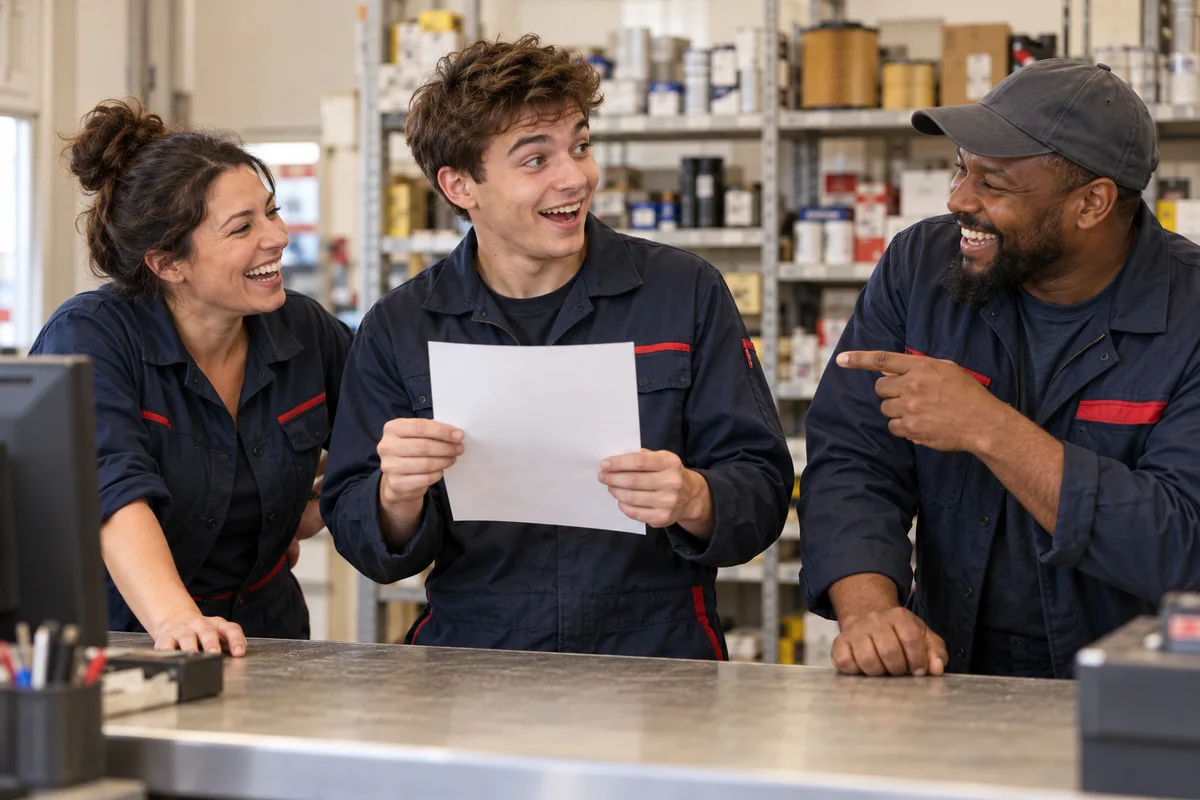
A fictional parts-counter exchange about blinker fluid, imaginary maintenance and the apprentice who asks for the missing filler cap.
Original fiction · characters and events invented
The first thing Ash noticed was that the list had no part number. The second was that Rob, who had handed it over, had suddenly developed a passionate interest in a perfectly ordinary shelf.
“Blinker fluid,” Ash read. “Do we keep that here?”
At the counter, Leila looked up from the real stock sheet. She looked at Ash, then at Rob, then at the blank space where the specification should have been.
“What vehicle is it for?” she asked.
Rob turned back. “The usual one.”
“We have a lot of those.”
Ash looked down at the list again. He had started in the workshop recently enough to have met several genuine products he had never heard of. An odd name did not bother him. A product for “the usual one” was beginning to.
“Where’s the filler?” he asked.
Leila folded her hands on the counter. This was now the most interesting order of the morning.
Rob opened his mouth, considered the available engineering, and closed it.
“Exactly,” Leila said. “There isn’t a blinker-fluid reservoir. It’s the imaginary maintenance joke.”
Ash stared at the list for a beat. Then his expression changed from serious stock enquiry to the pleased annoyance of somebody who had found the trapdoor before stepping through it.
“I was going to ask which grade,” he said.
“Very professional,” Leila replied.
“Summer blinking or winter blinking?”
Rob laughed first. Leila followed. Ash joined them, still holding the paper as if it were an unusually disappointing quotation.
“Do the left and right indicators use the same fluid?” he asked.
“Don’t give him another model,” Leila said. “We just closed the order.”
Nobody fetched a bottle. Nobody touched a vehicle. The whole stock request had become a conversation between three people who now knew they were discussing something that did not exist.
Ash turned the paper over. “I’d like to submit a return.”
“For which item?”
“The maintenance advice.”
Leila nodded gravely. “Keep the receipt. Imaginary advice has a very short warranty.”
Rob leaned on the far end of the counter. “I got sent for it when I started.”
“And did you ask for the filler?” Ash said.
“I asked for a large bottle.”
That was enough to set Leila off again. Rob was laughing at his own former confidence now, which improved the balance of the story considerably.
“So this is a family tradition of ordering the wrong thing,” Ash said.
“A workshop tradition,” Rob corrected.
“Then we should have a proper ordering system. Item description. Part number. Does it exist?”
“The last field would reduce our entertainment budget,” Leila said.
When they returned to the real list, Ash asked for the genuine part by its actual reference. Leila found it without a comedy specification, which was less memorable but considerably more useful.
Rob took the blank paper back. “You can save that line for the next break.”
“Which line?”
“The filler question.”
Ash smiled. “I thought I’d save the whole order. It’s the first one I completed without receiving anything.”
Leila handed over the real part. “Best stock accuracy we’ve had all morning.”
Blinker fluid is a joke. Vehicle indicators use electrical lamps or LEDs, not a fluid reservoir that needs topping up. Headlight-fluid and taillight-fluid errands use the same invented-maintenance idea.
Muffler bearings are an imaginary automotive part in the classic joke. An ordinary muffler quietens exhaust; it does not contain a rotating bearing set to replace. Other exhaust components can have moving parts, so ask which assembly is actually meant.
Piston return springs in an ordinary crankshaft-driven car engine are a fake-parts joke. The connecting rod and crank mechanism control the piston’s motion; a separate spring does not pull each piston back for the next stroke.